
ERP Implementation Service That Simplifies Complex Business Operations

Make Your ERP Implementation
Work the Way Your Business Actually Operates
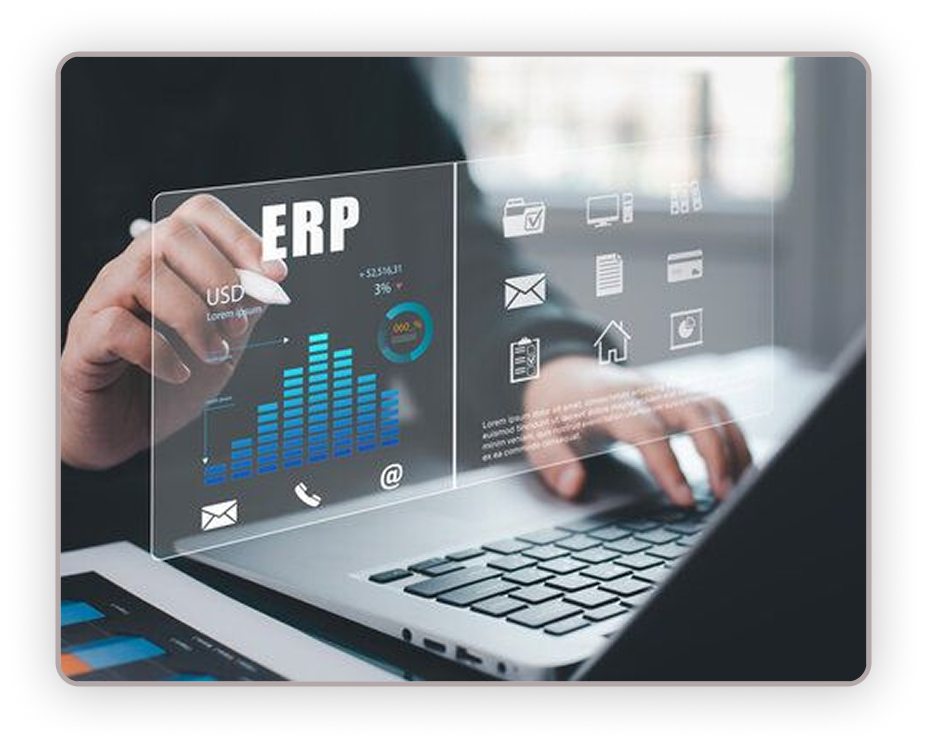
An ERP implementation is not merely about installing software; it is about creating a system in which all aspects of your operations run smoothly. ERP implementation services offered by us are aimed at matching the actual business processes, planning, configuration, deployment, and optimization. We make sure that your system is interdepartmental, links your data, and gets rid of the inefficiencies that slow you down.
Regardless of whether you are dealing with finance, operations, projects, or various business units, our approach to the implementation of the ERP system enables you to build a single and scalable environment that can enhance visibility, make workflows smoother, and facilitate smarter decision-making.
When properly implemented, your ERP not only runs your business, but it also runs it better, faster, and in a perfectly clear manner.
Challenges Customer Faces in ERP Software Implementation Services & How We Help
Current businesses are dependent on various platforms, including eCommerce, CRM, accounting, inventory, logistics, and when these systems fail to communicate, the business becomes disjointed and time-consuming. Below are the key challenges businesses commonly face, along with our ERP integration solutions.

Needs Assessment & Planning
Pain Points
- Existing processes are not documented, and as a result, during planning, key dependencies (e.g., order → inventory → invoicing) have been overlooked.
- The same process is defined differently by various departments (sales vs finance vs warehouse).
- The scope is defined on a high level and does not take into account edge cases such as partial deliveries, returns, and failed payments.
- Any inefficiencies (manual approvals, data entry duplications) are transferred to the new system.
The ERP is not constructed on the right assumptions. After implementation, the teams are unable to run real transactions without workarounds.
We do process-level mapping where transaction scenarios are validated, where all the steps (including exceptions) are considered, and then the system scope is defined.

System Customization & Design
Pain Points
- The typical workflows do not correspond to the way orders, approvals, or movements of inventory take place.
- Over-customization introduces rigid logic that breaks when business conditions change.
- Multi-step fulfillment or approval chains (e.g., critical workflows) are simplified or complicated.
- No obvious differentiation of customization needed vs. standard configuration.
The system is made hard to use, costly to maintain, and off track with operations.
We practice controlled customization, which entails the design of only what is necessary in the operation of the system, and the system remains scalable and maintainable.

Data Migration & Integration (Implementation Context)
Pain Points
- The new ERP does not have data structures that are comparable to legacy data (e.g., customers, SKUs, transactions).
- Important relationships (from order to invoice to payment) are not maintained in the migration.
- CRM, POS, and payment gateways post alternative or incomplete data into ERP.
- Duplicate or unstructured data leads to conflicts when using the system.
The operational errors, inconsistencies in reporting, and tracking of transactions across modules.
We match data structures to ERP logic, making sure all the records are relationally consistent and can be used in the established workflows.

Deployment & Go-Live
Pain Points
- System is deployed without validating full transaction cycles (order → fulfillment → invoicing → payment)
- Live environment behaves differently from testing due to real data volume and concurrency.
- No rollback or fallback mechanisms if critical workflows fail during launch
- Users encounter system errors during the first transactions without immediate resolution.
Operational disruption at launch, delayed order processing, and loss of confidence in the system
We execute controlled deployment with live transaction validation, monitoring system behavior, and resolving issues in real time.

Training & Change Management
Pain Points
- Users are trained on generic system features, not their specific day-to-day workflows.
- No clarity on responsibility ownership (who creates, validates, or approves transactions)
- Resistance from teams due to increased structure and reduced flexibility
- Users revert to old methods (Excel, manual tracking) when faced with friction
Low system adoption and inconsistent data entry across departments.
We deliver role-specific training tied to actual workflows, ensuring each user understands exactly how to perform their tasks within the ERP.
Post-Implementation Support
Pain Points
- Issues emerge only after real usage (e.g., incorrect financial entries, stock mismatches)
- No monitoring of system performance or transaction failures
- Minor issues accumulate, gradually affecting operational efficiency
- No structured process for system optimization as the business evolves
System degradation over time and increasing reliance on manual corrections.
We provide ongoing monitoring, issue resolution, and iterative optimization, ensuring long-term system stability.
What Makes Our Services Different
- Most consultants focus on technical delivery.
- We focus on business impact.
Here’s how we stand out:
We Don’t Just Implement ERP. We Make It Work.
ERP-First Approach
No distractions. No unnecessary add-ons. Just systems that run your business smoothly.
Certified Odoo Partnership
Deep expertise in one of the most flexible ERP platforms.
AI-Powered Implementation
Smarter workflows, better predictions, fewer inefficiencies.
Real Estate & Complex Operations Expertise
We understand industries where standard ERP simply doesn’t work.
User-First Design
If your team won’t use it, it’s not a solution.

Implementing ERP Easily: Our Plan to Go-Live.
Planning & Setup Workflow
Begin your ERP implementation clearly and organized:
Business Analysis, Process Mapping, System Planning, Requirement Finalization.
We know how your business operates prior to constructing anything.
Configuration & Build Workflow
Transform your requirements into a working system:
System Setups, Module Configuration, Customizations, Integrations.
We align your ERP to your processes, integrate your tools seamlessly.
Data Migration Workflow
Transfer your information in a smooth and non-loss manner:
Data Review, Data Cleaning, Migration, and Data Review Validation.
We ensure that your data is correct, complete, and prepared.
Post-Go-Live Support Workflow
Maintain your system and make it better:
Monitoring + Issue Fixes + Optimization + Continuous Support.
We stick around with you after launch to ensure your ERP keeps on functioning.
Testing & Go-Live Workflow
Install your ERP with surety:
System Testing - User Training - Final Adjustments - Go Live.
We will test all of this under actual conditions and train your team.
Get Your ERP Implementation Right
Eradicate process gaps before they turn into system failures.
Establish an infrastructure that will serve your business.

How We Use AI-Powered Implementation
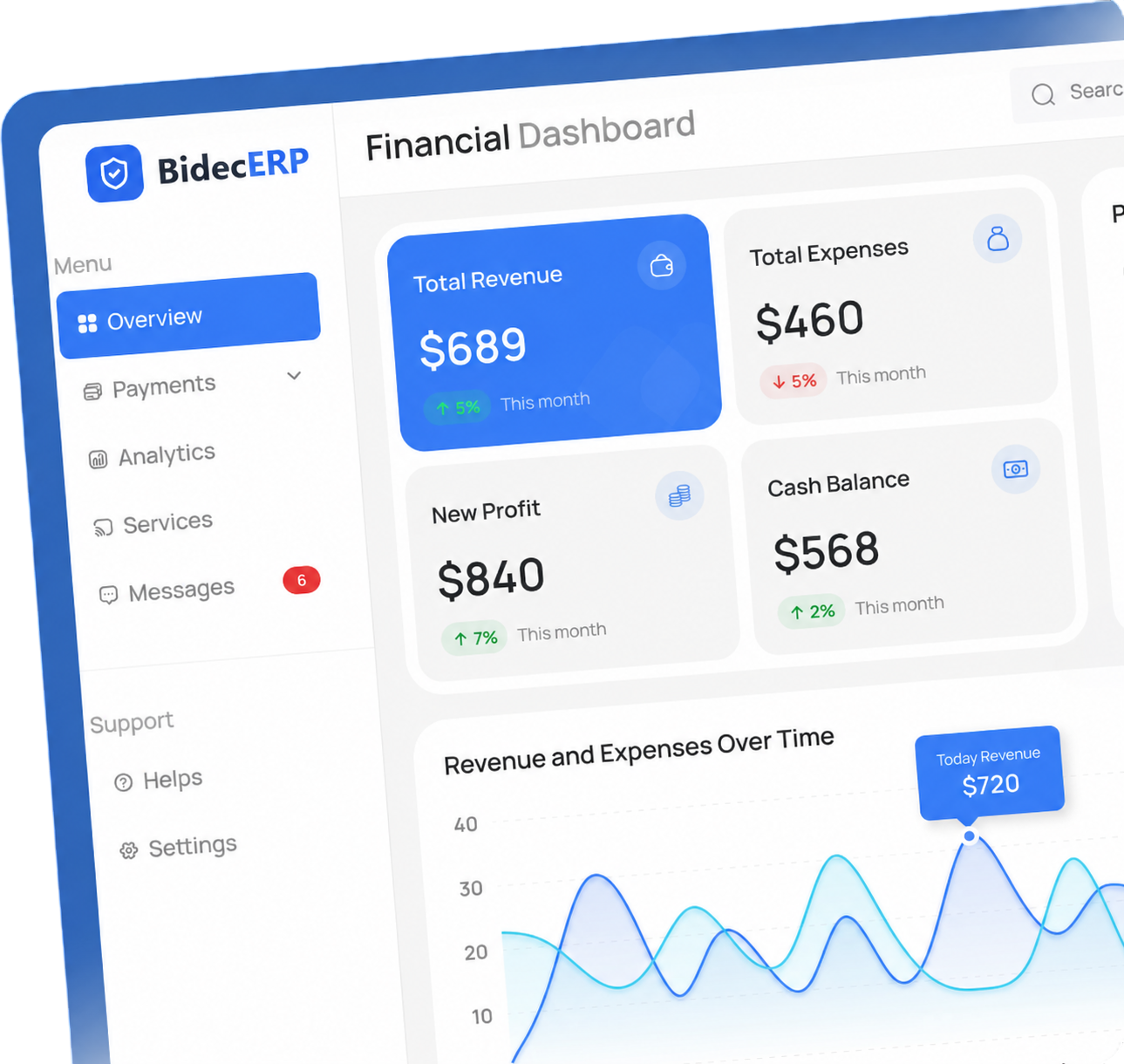
We offer more than using the ERP, we incorporate Artificial Intelligence for your business to be more efficient, adaptable and intelligent since the first day. Thanks to our innovative AI enabled approach, we automatically identify inefficiencies, predict bottlenecks before they occur, optimize processes, and produce smarter insights to support your decisions. Your ERP does not get into tools, but as a strategic advantage, to make more effective, understand and grow your business.
What our customer say?







Nora Al-Zahrani,
HR Manager
Before this system, our HR team was handling everything manually across spreadsheets. Payroll took days and errors were common. Now everything runs through one system and the process is significantly faster. This is the best HR software solution we have used for a real estate business.
ERP Implementation Cost Overview
| Factor | What It Includes | Cost Impact |
|---|---|---|
| Scope of Implementation | Modules implemented (sales, inventory, finance, projects, etc.) | More modules increase configuration effort |
| Business Process Complexity | Number of workflows, approvals, and operational dependencies | Complex processes require deeper system design |
| Level of Customization | Custom workflows, approval hierarchies, and business-specific logic | Higher customization increases development time |
| Number of Users | Total users across departments (sales, finance, operations) | More users increase setup, access control, and training effort |
| Workflow Automation | Automated approvals, triggers, and task flows | Advanced automation increases configuration complexity |
| Data Readiness | Structured vs unstructured data used during setup | Poor data structure slows implementation |
| Reporting Requirements | Custom dashboards, KPIs, and operational reports | Advanced reporting adds configuration effort |
| User Roles & Permissions | Role-based access control and approval structures | More granular control increases setup time |
| Training & Onboarding | Role-based training sessions and documentation | Expands project scope and timeline |
| Project Type | Business Size / Use Case | Estimated Cost |
| Basic Implementation | Small teams, limited modules, standard workflows | $3,000 – $10,000 |
| Standard Implementation | Growing businesses with multiple departments | $10,000 – $30,000 |
| Advanced Implementation | Complex workflows, automation, and role structures | $30,000 – $70,000 |
| Enterprise Implementation | Large-scale operations with full system configuration | $70,000+ |
Why Choose Bidec for ERP Services
| Feature | Bidec Solutions | Typical Providers |
|---|---|---|
| ERP Focus | ERP-first specialists | Mixed services |
| Odoo Partnership | Certified Odoo partner | Limited expertise |
| AI Capabilities | Built-in AI optimization | Rare or none |
| Approach | Business-first | Tech-first |
| Scalability | Designed for growth | Often limited |
| User Experience | Simple & usable | Complex |
ERP Implementation Services We Offer
Full Implementation
ERP Software Implementation & Setup

Custom ERP Configuration

Data Migration & Integration

ERP Optimization & Support

Meeting with the ERP implementation consultant

Results-Driven Metrics
Industries We Serve
Expertise You Can BidecSol is a certified, experienced, and results-driven ERP advisor and implementation partner in Saudi Arabia. driven.
One ERP. Built for Your Industry. Ready for Your Growth.
No matter your industry, the right ERP implementation brings clarity, control, and consistency to your operations, without unnecessary complexity.
Frequently Asked Questions
You Have Different Question?
1. What is ERP implementation?
ERP implementation refers to the process of designing, developing, and installing an ERP system in a way that replicates your business operations, workflow, and transactions and meets your business needs. This involves installing modules, process definition, and making sure that all departments are incorporated into a central system.
2. What is the time of implementation?
The timeframe will be based on the sophistication of your processes, user count, and desired settings. We provide the implementation in a series of stages, so that you can begin to use important functions early, with the rest of the system being finished in parallel.
3. What are typical ERP issues?
Challenges that are common are poorly defined workflows, low adoption of the system because of a difficult-to-understand system design, inconsistent data structures, and extreme customization that makes the system hard to maintain. These problems are usually caused by the implementation not being in line with actual business processes.
4. Do you offer ERP consulting?
Yes. Our ERP consulting services include requirements analysis, process mapping, system design, and implementation strategy. We take you through all the phases to ensure the system aligns with your operational and business objectives.
5. Are you able to use Odoo ERP?
Yes. We are experts at deploying Odoo and have experience in adapting its modules to fit intricate business processes, to provide a scalable and effective system architecture.
6. Will the implementation of ERP interf ere with my business?
No. To reduce disruption, our implementation strategy will take into account all deployment planning, validate workflows prior to launch, and ensure that teams are ready to work in the new system on the first day.